
Tom chose us

We live in town, but in a neighborhood that was a suburb of the city before it was annexed a hundred years ago. Our street was generally built out in the early 1950’s, and leans heavily toward midcentury ranch houses – but plan book houses for ordinary people, not anything like you would see in Dwell magazine.

The lots are large for city lots – ours is ½ acre, and is on the smaller side of average. A neighbor down the street has three acres. The lots are wooded, with fifty foot tall pines and oaks and magnolias everywhere. And also, stray cats.

Our neighborhood has a pretty severe feral cat problem. It’s a combination of negligent pet owners, biology (cats have LOTS of kittens) and lack of a proper animal control office in our city. There are no easy solutions on a policy scale, but on an individual scale, it’s pretty simple: trap the ferals and get them fixed, and then release them back in your yard. It’s simple, but not cheap – a spay or neuter can easily cost you $250, and that would be cheap. It’s not all that easy either, as you have to hunt to find vets that will work on ferals, you have to trap them, and you have to have space for them to recover for 24 hours at a minimum.

But, if you can swing it, it works. The now sterile cat keeps the territory safe from other cats, and she (or he) will live in your neighborhood for years without making new kittens. It breaks the cycle.

We first noticed Tom over the winter of 23/24. A large orange cat who would come up on our deck and eat the food we put out for the ferals (so we can trap them), we saw him first on the security cameras. At the time, we were working on adopting out a set of kittens another feral had had in our backyard, and one of those kittens was a straight up ginger, so we assumed this was the father. I called him Tom, because some 80% of gingers are male.

I would see Tom in the back yard sometimes, but always at a distance, and I would chide him for neglecting his parental duties. I would tell him that it was irresponsible to go arund getting other cats pregnant and then not sticking around.

Tom was unphased, and would duck into the hedgerow when I approached.

But one day, I stumbled across a batch of kittens, just a few days old, in a hollow tree stump in our backyard, the second batch we had found that summer. Mom was nowhere to be seen, but that didn’t mean they had necessarily been abandoned. Momma cats rarely abandon kittens unless they are obviously damaged or dying. It was far more likely she was just off hunting.

If you are going to rescue kittens, it is so much easier, by several orders of magnitude, if you can trap the mom too. Because then you don’t have to feed the kittens every 3 hours for six weeks – you just have to feed Mom, and she does all the hard work.

 So, we set a trap for her, using the kittens as bait. You put the kittens in a pet carrier, then put the trap in front of it, and cover the whole thing in a blanket, leaving the mouth of the trap exposed. The momma cat smells her kittens, and to her mind, they have been moved to the end of a tunnel. She goes into the tunnel to explore, and BAM! The trap closes.

So now we had four ginger kittens and, surprise, a Ginger mom, our old friend Tom, who we had been misgendering all this time.

For the next six weeks, we would feed Tom and the kittens, who all lived in our garage storage room. We would go in and put food in the bowl, and Tom would hiss at us. By the end of the six weeks or so, when she began weening the kittens, her nipples sore and achy, she would tolerate our presence as we played with the kittens, but if you approached her, more hissing and screaming at us.

It was almost September when we got Tom to the vet and got her spayed. Two days later we released her back into the backyard, exactly where we had trapped her almost two months before. She darted from the trap and back into the hedgerow, free at last.

Two days later she was back on our back deck, eating the feral cat food. We would see her from time to time, sunning herself in the yard. We learned she slept at night in our flower bed.

And then one day, she started showing up when we were putting the food out. She would sit at the other end of the deck and watch us, and then run up to the bowl when we walked away.

And then she started sitting two feet away from us as we filled the bowl.  And then, sometime early this year, nearly two years after she had kittens in our backyard, she declared us safe, and now she rubs against our legs as we pour food in the bowl. She will follow us around as we water the plants on the deck. And, sometimes, she will allow me to pick her up and pet her. She looks a bit nervous, but she allows it, and then when I set her down, she doesn’t run away but will continue to rub against our legs.

She is on our deck most days now. She still sleeps in the flower bed out front, a permanent dead spot marking her shelter among the perennials. Every morning, she greets me when I leave the house, and will sometimes stand at the gate to the deck and fuss at me to open it, despite her being completely capable of getting over it herself, like she does countless times a day.

She’s a pet now, I guess; a permanent resident on our property. Outdoor cats are bad for the bird population, but we have modified things a bit to make it safer for the birds, like making sure there is clearance around water sources and that bird feeders are not just baiting them as a hunting hide for cats.

I would never choose an outdoor cat, but it seems like Tom has chosen us.

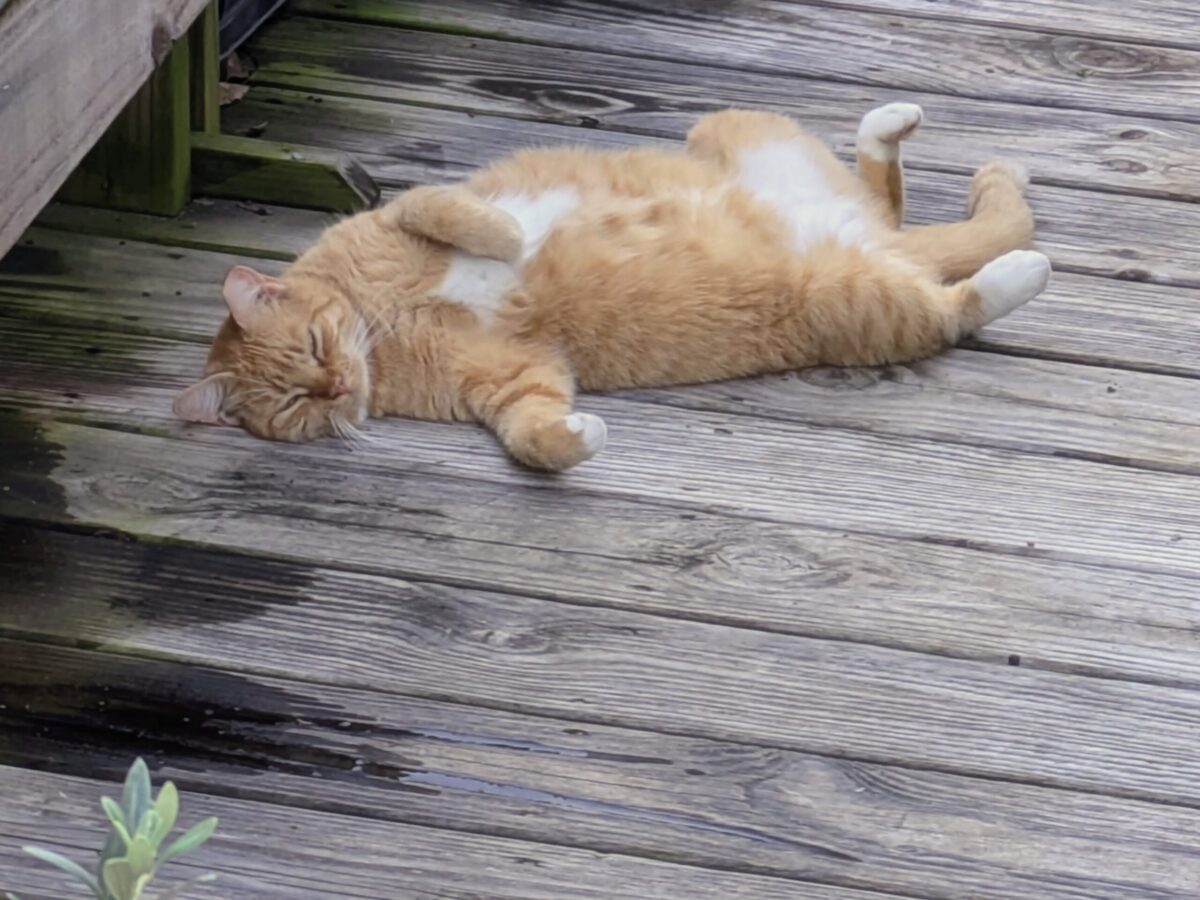
The other day, I saw her lying on the deck, sound asleep, belly up in the air. Cats bodies are most vulnerable underneath – they only show their stomach when they feel safest. And I guess for Tom, that space of safety is our back deck.

I’ve spent a large part of my career working with victims of trauma, and one thing I have learned is that you cannot heal from trauma while you are still experiencing trauma – you have to have a safe space to heal.

I’m glad we are able to be that space for Tom.
The dead hedge

Our half-acre lot is a rectangle, with our house running perpendicular to the wide side, with a quarter of the lot being front yard, and the rest being back yard. And in the backyard, where it can harm no one, is a large hackberry tree.

Or perhaps more accurately, was a hackberry tree. It’s now actively dying, and has been since the great drought of 2024. It has died from the top down, so that even today the lowest branches leafed out this year, while the topmost limbs have been decaying and falling for a few years now.

It isn’t near anyone’s house or other structures, so we have been content to let it continue to die a natural death. This is best for the other creatures that live on our property – bugs move in, followed by woodpeckers, followed by cavity dwellers. We have arranged native vines to run up the tree trunk, so it also provides food and cover for birds and flowers and green foliage in the summer and autumn color for us.  

But it is messy. After every rainfall, there are dead limbs beneath it that no longer had the strength to hang on. What, exactly, is one to do with this debris? It’s a huge tree, so we are not just talking about 1 or 2 limbs.

There are many things one could do, I guess. I could have cut them into pieces and taken them to the dump, or burned them in my backyard fire pit, or made hügelkultur garden beds. But instead of any of that, I made a dead hedge.

A dead hedge is simple a decorative brush pile. Now, people from the UK, where they are so ahead of us on wildlife gardening, would fight me over that statement, but that is really what it is. A google image search of dead hedges brings up a wild amount of variation, but the concept is simple: Use tree debris like prunings and dead wood to create piles where wildlife can hide, where compost can happen naturally, and they are out of the way of humans.

Brush piles in and of themselves are amazing for wildlife. They provide cover for small mammals and birds, they provide food and cover for bugs and amphibians and reptiles, and they provide structure for other plants to grow on and through. But they tend to be seen  as ugly by humans. Or, at least, 21st Century humans living in suburban neighborhoods in the USA. Other cultures have long since learned how to manage this.

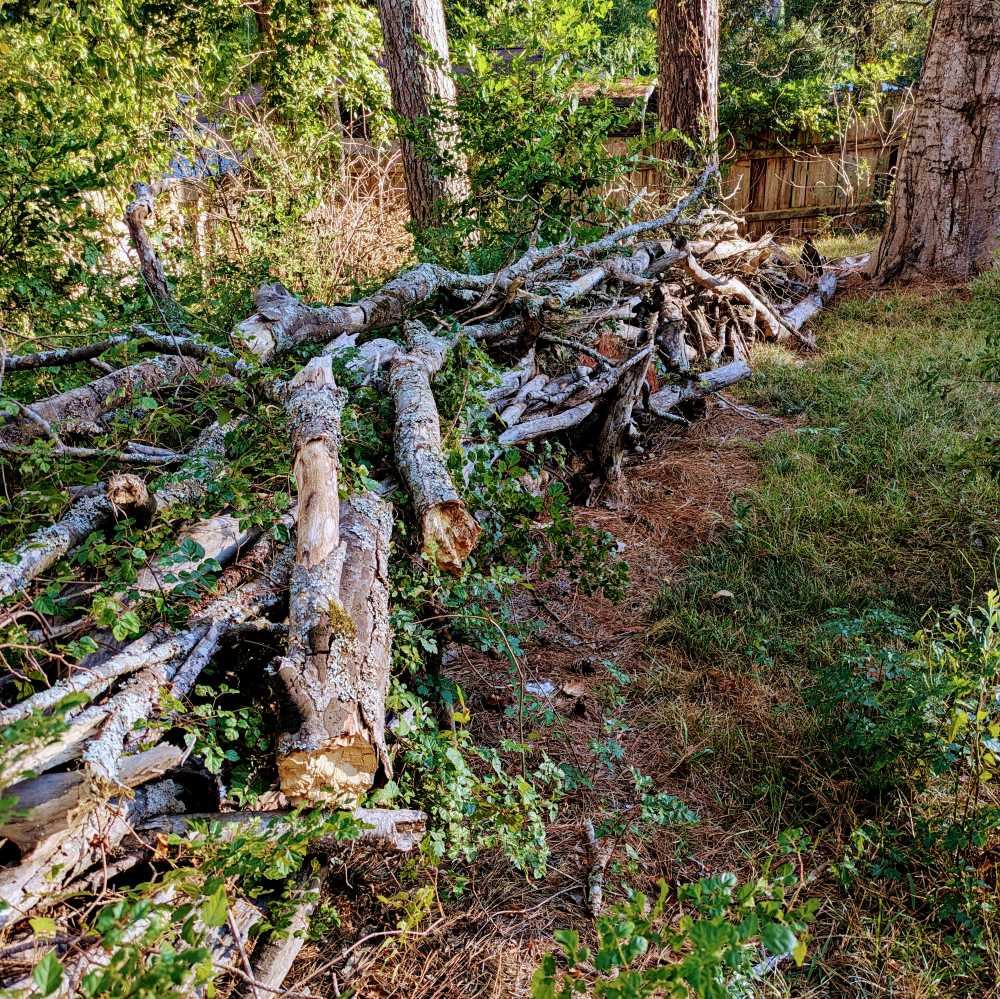
So as the limbs fell from the hackberry, I laid them along an imaginary line, somewhat crenellating, across my back yard, some 30 feet in front of my rear boundary. It is now almost fifty feet long, some four feet wide, and about four feet high. As I have trimmed other shrubs and trees, I have woven their supple limbs in and out of the bigger, dead ones, and we have allowed the native crossvines and pepper vines to grow rampant , so in the summer portions of it are invisible. A few seedling cherry laurels have come up in it, gifts from the birds who roost there. We have left the cherry laurels, and so now the dead hedge is becoming the foundation of a hedgerow. It is one of the most alive places on our property, filled with lizards and birds, and bugs and the snakes that eat them.

Over time, it will change, as the smaller limbs break down and the bigger limbs shift. It also changes as I add new limbs as they fall, and the leavings when I prune the other bushes and trees. It’s an everchanging organic sculpture.

But it is also more than that.

Between the dead hedge and my back fence I have planted wax myrtles, black cherry, and yaupons, and the birds have planted the cherry laurels and some black cherry and elderberry of their own. There are four pine trees in this strip as well, dropping their pine straw obligingly on the ground to serve as mulch.

This is on the eastern side of our yard, and so there is one side of the base of the dead hedge that only gets morning sunlight, while the other side bakes in the sun all afternoon. We are content to let this 30 by 100 foot strip be woodland, but managed, with a path that weaves among the saplings, which I limb up from time to time to make it more navigable. In the mornings I like to walk this path, and hear the birdsong and see the skinks and the anoles, and hear the brush rattle as some small mammal runs to hide from my intrusion into their home.

When we moved in, this rear boundary was a typical privacy fence against lawn grass, barring the four pine trees and the one hackberry. But now, eight years later, it’s habitat.

Antique Roses and Native Plants

It’s been a long day, and I’m beat. But the yard is really starting to wake up, so here is what’s in bloom this week.

Since the overwhelming goal of my gardening efforts is to make a happy habitat for all the animals that live here (including those of us with two legs), I have some plants that serve no purpose other than they are, to my eye, beautiful.

Like my antique roses. These are ancient, hardy roses that grow neglected in cemeteries and along fence rows, that nobody waters or prunes, and are all well adapted to grow and bloom with zero care. Zero care is sort of a specialty of mine.

Like this Mutabilis rose. It goes back to before 1894, blooms from spring to fall, and has beautiful flowers that start pale pink (like this one), and then get darker and darker until they turn crimson. I just planted this one a few weeks ago, and this is the first bloom.

Then there is Peggy Martin, the so-called Katrina rose. They call it that because a woman who had a huge rose garden had to evacuate because of Katrina, and her yard was underwater for two weeks. When the water went down, the only thing still alive was her Peggy Martin rose. If it won’t die with being underwater for two weeks, I am unlikely to kill it.

It’s a vigorous climbing rose, so I planted it at the corner of the vegetable garden, so it can run along the fence. I planted it over the winter, and it is blooming galore. The blooms fade fairly quickly in the hot sun, but more just come along.

Also, I planted it before I finished the fence, because of lumber prices. But now it’s starting to grow, and I have to hurry up and finish the fence to have something to trellis it on.

This rose isn’t an antique but is extremely special. When The Boy lived with us in 2020, he loved the color orange. We were in Kroger, back before the pandemic, and he saw a “miniature” rose with orange blooms in a pot in the floral department. He wanted it so bad. We bought it and planted it in one of the flower beds.

The whole time he lived with us, he watched it like a hawk, with near-daily reports to us on the blooms that appeared. When we planted it, I didn’t have high hopes of its survival. Such plants are usually pretty tender, sold to folks who manage to kill them pretty quickly. But he liked it, and it was less than $10, so why not risk it? Well, it survived the two winters since and is now in full bloom and I miss that kid something fierce right now.

Because of reasons, I didn’t put in a spring vegetable garden this year (lumber prices, for me to finish the raised beds, mainly). It’s not a huge deal – we can plant tomatoes here as late as the end of August and still get a crop. But anyway, the sage in my herb garden is blooming.

I love coneflowers. These are all varieties of purple echinacea or Purple Coneflower. Yes, one of them is white. It’s a variety bred for that trait. Coneflowers are native here, which means the pollinators love them and they are near bulletproof, but there are some native plant types that will lecture you about planting native plants that are bred to purpose (so-called nativars), like my white Purple Coneflowers. But we won’t invite those people over, anyway.

Not quite open yet, but it’s coming!
A white Purple Coneflower.
The pure species, with some tickseed in bloom behind it, and a slew of rudbeckia seedlings.

I need to do a whole post on our chickens. But here is our coop – my Mom says it’s the nicest chicken coop she has ever seen, but to be fair, she doesn’t get out much.

Last fall, a new neighbor moved in next door and cut down all the trees in his front yard. (I have opinions about this, but that’s another post). As a result, the whole north half of my front yard is now in full sun, so I put in blackberries and blueberries, among other things.

Ms. June is an 89-year-old lady who lives up the street, and who has an amazing shade garden in her backyard. She gave me these Indian Pinks, which are just showing out. I don’t have a good picture of it, but I also got a Japanese maple from here, which the Indian pinks are planted under. In 4-5 years, that’s gonna be nice.